

Run out of food on a regular Old School RuneScape account, and you can buy more. Run out on an Ironman and your next boss trip might start at a fishing spot. On a Group Ironman, you might ask who emptied the shared supplies. On an Ultimate, you also need somewhere to put them. Those differences between account types will shape far more of your time than the icon beside your name in OSRS.
Before choosing a mode, think about the ordinary sessions between the big drops: gathering, preparing, banking, and getting ready to try again. Make the choice before leaving Tutorial Island. Speak to the Ironman Tutor if you want a restricted mode: once you leave as a regular account, you cannot turn that character into an Ironman or its types in OSRS.
Regular: Keep Your Options Open
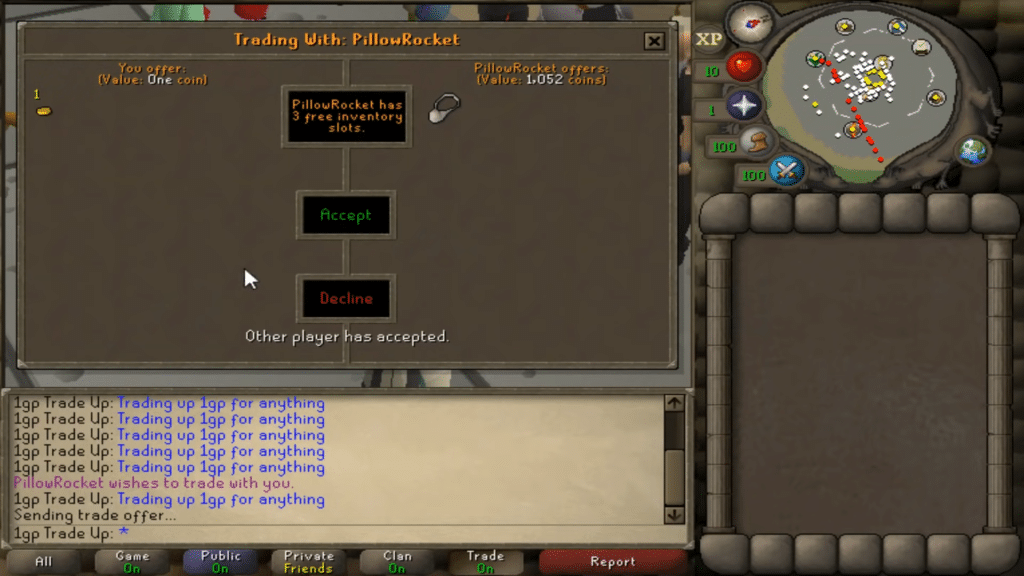
A regular account gives you access to player trading and the Grand Exchange. If you need a tradable upgrade, you can earn the money doing something you enjoy and buy it, rather than camp the monster that drops it.
For a new player, that leaves room to discover which grinds are enjoyable before building a routine around them. You can learn quests, try bosses, and change plans without every missing supply becoming another job. Untradeable rewards still give you goals you cannot simply buy off the Exchange.
It also leaves room for your own restrictions. A pure that keeps Defence low is a specialised build, not a separate Ironman mode. You can pursue that kind of account while retaining access to the economy, though you need to check quest rewards and combat types before gaining experience you cannot undo in OSRS.
The temptation is to judge everything by how much gold it earns. If you keep abandoning activities you like because another one pays better, Ironman may suit you more.
Ironman: Make the Supplies Part of the Game
An Ironman cannot trade equipment or supplies with other players or buy them from the Grand Exchange. You source your own items through gathering, crafting, shops, and drops. Bonds are a specific Exchange exception, not a way to buy gear.
Take the Dragon Warhammer. A regular account can save up and buy one; an Ironman kills lizardman shamans until it drops. The weapon is the same, but the evenings spent getting it are very different.
Preparation matters too. Fishing fills the food supply. Farming supports Herblore. Those sessions move the account forward even when no new equipment types land in your inventory in OSRS. The appeal lasts only if you enjoy enough of that preparation. Wanting to earn your own rare weapon and wanting to replenish your own potions are separate preferences. Ironman gives you both.
Self-sufficiency does not mean every encounter must be solo. Some content supports Ironmen playing alongside others, although loot restrictions apply. For ordinary monster drops, outside help can invalidate your claim to the loot.
Choose Ironman if building the account from its own resources sounds satisfying. Having fewer hours to play does not automatically rule it out, provided you are happy for goals to take longer.
Hardcore Ironman: Decide What the Red Helmet Will Change
Hardcore adds one dangerous life to the solo Ironman rules. Lose it, and the account becomes a standard Ironman; your progression continues. Certain activities have safe deaths, including the Fight Caves, so “one life” does not mean every death ends Hardcore status.
The more useful question is whether the helmet will make you play differently in ways you enjoy. Planning an escape, preparing extra supplies, and surviving a close call can make familiar content exciting again. But if protecting the status means indefinitely postponing every boss you wanted to learn, the restriction is choosing your sessions for you.
Start Hardcore if that tension appeals. Decide beforehand whether you would keep playing after a death, so the answer does not depend entirely on how annoyed you are when it happens.
Group Ironman: Choose the Team Before the Mode
Group Ironman lets two to five players share the work. Members can trade within the group and use shared storage alongside their personal banks. You still cannot shop for equipment on the Grand Exchange.
One player can focus on gathering while another pushes combat, and duplicate drops can equip teammates. You do not all need to be online together for supplies left in storage to help someone else.
You do need compatible expectations. Talk about shared gear, playtime, and what happens when someone takes a break. A friend who wants two relaxed evenings a week has not agreed to become the group’s full-time potion supplier.
Unranked groups make changing teams more flexible, but permanently give up their place on the Group Ironman leaderboard. Hardcore groups share a pool of lives, initially one per founding member. One player’s deaths can exhaust the pool for everyone. Their death rules are stricter than solo Hardcore: Fight Caves and Inferno deaths cost a group life, even though both are safe for a solo Hardcore.
Ultimate Ironman: Enjoy Solving the Inventory Problem
Ultimate adds a defining restriction: no normal bank access. A regular Ironman can bank an item needed for a quest next week. An Ultimate has to decide whether carrying it until then is worth the space, find an allowed storage option, or get another when the quest comes around. Even a cheap item can become an awkward decision.
Choose it because that planning sounds interesting. If inventory management already irritates you on a regular account, removing the bank is unlikely to improve matters.
Conclusion
The restrictions also affect outside help. With OSRS services, an Ironman gathering order means someone collecting resources on the account itself; supplies cannot simply be traded in. Regular accounts allow more flexibility in preparing equipment. TonsOfXP also accepts Hardcore orders, but says it does not take responsibility for deaths. Hiring a trainer does not guarantee the helmet survives.
You can later remove Ironman status through the tutor, subject to a seven- or 90-day waiting period. You cannot reverse that decision once the account becomes regular.
Before leaving Tutorial Island, picture an evening when the rare drop does not arrive. Would you still enjoy gathering the supplies, helping your group, or working around your inventory? Choose the restrictions you want to live with on that evening. The big rewards are occasional; the routine is what you are signing up for.